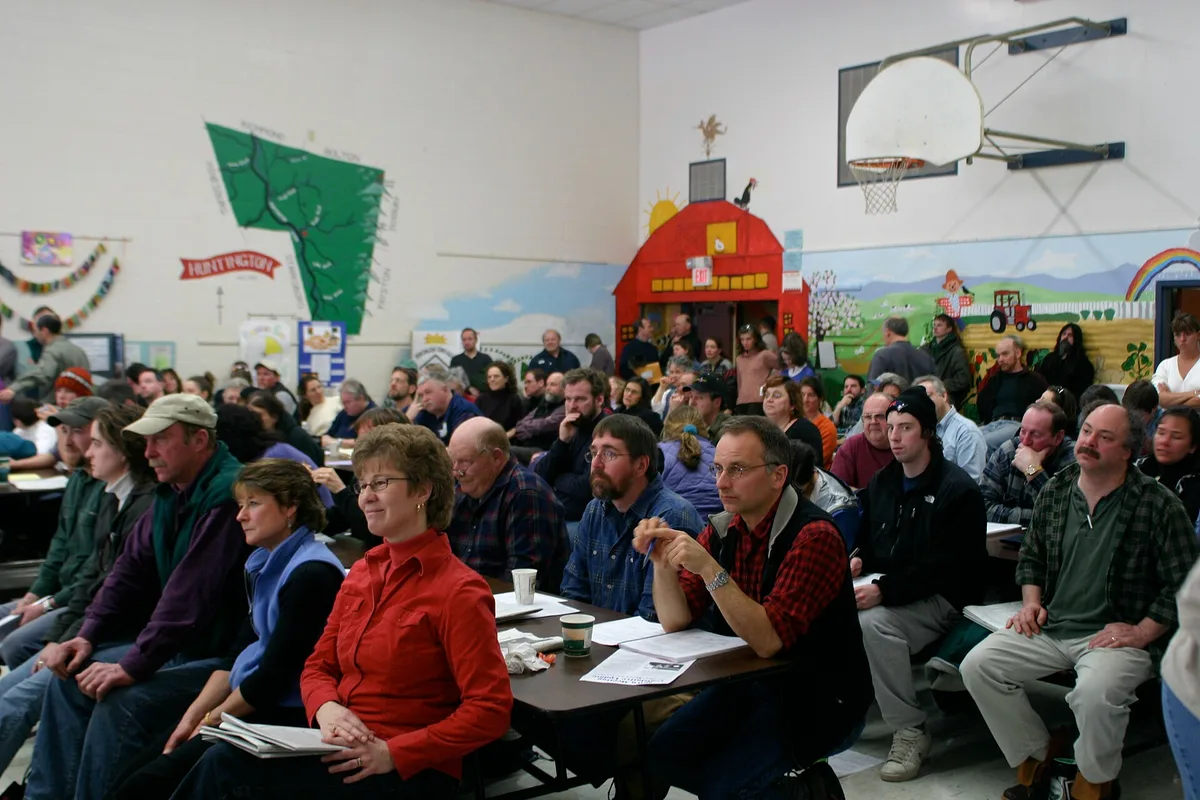
Picture the scene: a community room at town hall, folding chairs half full, a board member calling the agenda to order. Somewhere between the second and third item, a resident stands up with three minutes at the microphone and asks a question about a culvert on her street. That ordinary moment is the machinery of local government running in public.
A town meeting in Rockland is where the decisions get made in the open: budgets adopted, contracts awarded, zoning changes debated, and residents given a window to speak. You do not need an appointment, a lawyer, or a reason. You need to show up, and to know which part of the night is yours.
This guide explains how the process works, when to speak, and how one voice can shift an outcome. It covers what a town actually is in New York's system of local government, what happens at a typical meeting, and the practical steps that make a three-minute comment land. For the broader picture of how local institutions fit together, the government section collects our explainers on boards, budgets, and hearings.
What is a town, and who runs it?
The word gets used loosely, so it helps to start with the definition. In the United States, the term is often applied to incorporated municipalities, and the Wikipedia entry on towns notes that towns frequently exist as distinct governmental units with legally defined borders and some or all of the features of local government, such as a police force. That is the sense that matters here: Rockland's towns are legal corporations with boards that hold real powers, including zoning, contracts, and the tax levy.
Each of Rockland's five towns is run by an elected town board, usually a supervisor plus board members, that acts as the legislative body. The board adopts the budget, votes on resolutions, and appoints people to boards like planning and zoning. Our explainer on the Clarkstown town board walks through those duties in detail, and the same broad structure applies across the county's towns.
Why does that matter for showing up? Because the board is where the decision sits. A comment made anywhere else is a comment made to the wrong room.
What actually happens at a town meeting?
Most regular town board meetings follow a predictable arc. The board convenes, often approves the minutes of the prior meeting, works through a written agenda of resolutions and contracts, and handles business that state law requires to be done in public. Many boards also hold a public comment period, either at the start or the end.
Scheduled public hearings are different. A hearing is a formal part of the agenda for one specific matter, such as a budget, a zoning amendment, or a special district change. State open meetings law requires that government business be conducted in sessions open to the public, and a hearing is the structured version of that openness: the board must listen before it votes.
Here is what that means in practice. If the item you care about is on the agenda as a resolution, your comment may be noted but the board may not debate it. If the item is the subject of a scheduled hearing, your comment is part of the official record the board considers before deciding. Timing matters, and the agenda tells you which night is which.
When do you get to speak?
Boards set their own comment rules, and they vary. Common patterns include a fixed comment period with a time limit per speaker, sign-up sheets before the meeting, and a rule that comments address items on that night's agenda. Some boards take comments only at hearings; others welcome general comment at every regular meeting.
The reliable way to know is to read the agenda, which towns post in advance, and to check the board's posted meeting rules. If the rules are unclear, a call to the town clerk's office gets you a plain answer. The clerk is also the keeper of minutes, which is how you confirm what was said and decided after the fact.
A few practical steps make any comment stronger:
- Find the agenda online before the meeting and identify the item by its agenda number.
- Note whether the item carries a scheduled public hearing or sits in general business.
- Write your main point down and lead with it, in one sentence.
- Bring a copy for the board and the clerk, so your comment enters the record even if your time runs short.
- Follow up by checking the minutes and, if a document you need is missing, use our guide to requesting public records from Rockland's town and county governments.
Can one voice really change an outcome?
Sometimes, yes, and it helps to be honest about how. A single speaker rarely flips a vote on a settled matter. What one voice can do is change what the board knows, what gets asked, and what gets written down.
Boards respond to specifics. A resident who names the parcel, the section of road, or the line item, and asks a question the board cannot answer on the spot, often forces a delay, a site visit, or a request for more information. That delay is an outcome. It buys time for neighbors to organize and for the board to look again.
Hearings amplify this. When several speakers raise the same specific concern at a hearing, the board must address it before voting, and the record shows it did. Our coverage of what planning boards actually approve shows the same pattern in land-use cases: detailed, documented comments shape conditions, and conditions shape the project.
What this means is simple. Showing up is not symbolic. It is the input step of a process, and the quality of the input affects the output.
Where else can you take the same voice?
Town meetings are one forum among several, and picking the right one is half the work. County-level decisions, such as the budget, sit with the county legislature rather than a town board, and our explainer on how the Rockland County Legislature works covers its hearings. Village matters run through village boards, with their own budget cycle described in our piece on how a village budget gets made in Rockland. This connects to our earlier piece, How a village budget gets made in Rockland: from the treasurer's draft to the board's final vote.
Appeals and variances go to a zoning board, not the town board, as our guide to Ramapo's Zoning Board of Appeals explains. And if your concern is a service or benefit rather than a decision, community programs may be the better door; see our overview of community action agencies and what services they actually offer. Readers following this should also see Community action agencies: what services they actually offer.
The through-line across all of these forums is the same: decisions are made by small boards, in public, on written agendas, with a listening window. Learn the window and use it.
What to remember before you go
The evidence of how local deliberation works points to a short list of takeaways. Read the agenda first, because it tells you whether the item you care about gets a hearing or only a mention. Speak in specifics, because boards act on facts and questions, not on applause. Put your comment in writing and hand it to the clerk, because the written record outlives the meeting. And match your issue to the right board, because showing up to the wrong meeting is the most common way a good comment goes nowhere.
What remains unknown, from town to town, is the exact comment format each board uses. That is not a secret; it is posted. Check the agenda, call the clerk if needed, and treat your first meeting as reconnaissance. The second one, you will know exactly when to stand up.