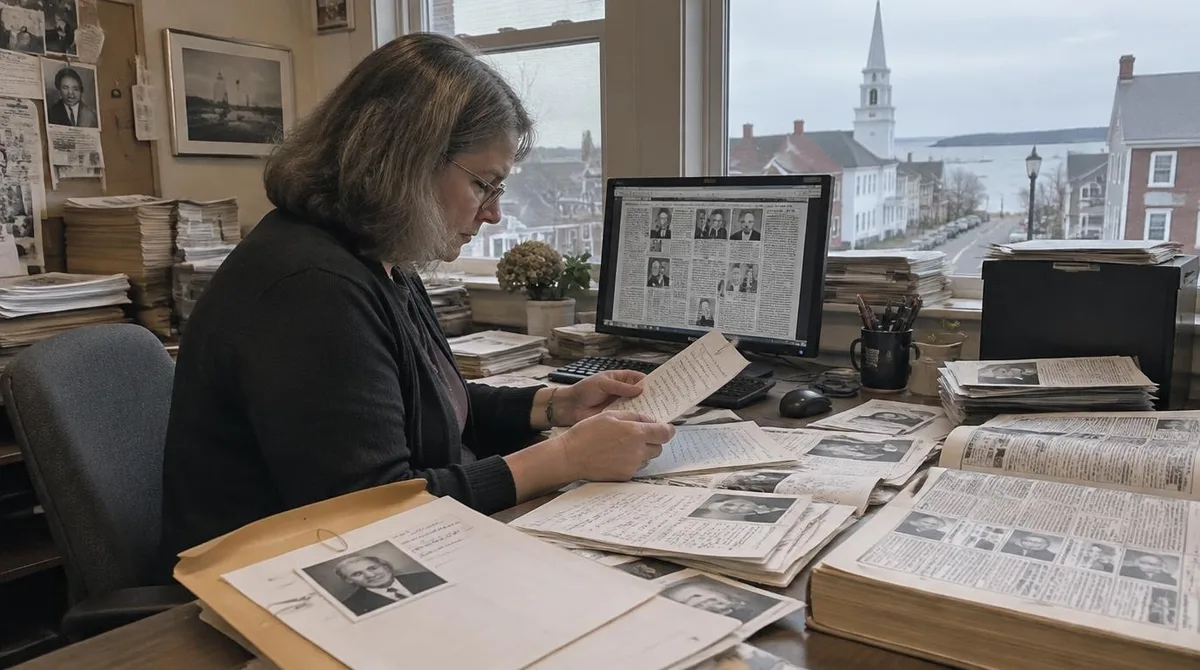
The obituary page is one of the last places a whole community appears in print together. The notices are written by families, gathered by funeral homes, and compiled by a newspaper's records desk into a running list: who died, when, where, and what their life looked like. What looks like a simple list is actually a small production, and it doubles as a public record that outlives almost everything else a paper publishes.
That is why obituaries matter beyond the funeral week. Genealogists, historians, lawyers settling estates, and neighbors checking on someone they knew all rely on them. A death notice published today may be the only dated, public account of a life that exists fifty years from now.
Here is how those pages get built, what belongs in a notice, and why the archive behind them is worth protecting.
How does an obituary actually get published?
The process starts with the family, usually through a funeral home. The family drafts the notice — the name, dates, surviving relatives, and a short life story — and the funeral home passes it to the newspaper, often with a photo. The paper's staff then checks the basics, formats it to house style, and slots it into the obituaries section alongside the others received that day.
Most papers treat these as paid notices, which is why wording varies so much. Some read like short biographies; others are one sentence. The newspaper's role is less about writing and more about compiling: collecting the notices, keeping the dates straight, and publishing them in a consistent place readers know to check. Readers following this should also see Spring Valley community centers: which halls exist, who runs them, and how to book one.
A good example of the compiled form is the obituaries page of the Columbia Basin Herald, which gathers current notices for Moses Lake and the surrounding area in one running list. Each entry there follows the same pattern — name, age, date and place of death, and a few lines on the person's life — which is exactly the shape readers expect when they scan a community's obituary page.
What goes into a typical notice?
Most notices cover the same ground, in roughly the same order:
- The full name, age, and hometown.
- The date and place of death.
- Where the person was born and raised.
- Work, military service, and community involvement.
- Surviving family members, and sometimes those who predeceased them.
- Service details — the funeral home handling arrangements, visitation times, and burial plans.
Notice how much verifiable information sits in that list. The example above from the Columbia Basin Herald shows it in practice: one notice records that a man died at a named care facility in Moses Lake at age 92; another notes a woman born in Caruthersville, Missouri, in 1944, who died in Moses Lake at 82. Those specific details — birthplaces, facilities, exact dates — are what make a notice useful as a record rather than just an announcement.
Families usually control the tone. That is why some notices are plain and others are warmly personal. The newspaper's job is to preserve the family's account accurately, not to rewrite it.
Why do obituaries matter as local records?
An obituary is often the best single document for tracing a family's history. It names parents, spouses, children, and hometowns in one place. It can confirm a birth year, a military service, or a move across the country. Official death certificates exist, but they are not always easy to get, and they carry none of the story.
That is why genealogy sites index obituaries so heavily. Index pages like the Grant County, Washington obituary directory show how the pieces fit together: a local paper's obituaries sit alongside funeral home listings, state death-certificate indexes, and paid genealogy archives, all pointing back to the original notices. The newspaper notice is the source; everything else is a way of finding it.
For a county like Rockland, the same logic applies. A notice published in a local paper today becomes part of the historical record that the county's historic societies and local researchers draw on decades later. Papers that keep clean, dated, searchable obituary archives are quietly doing preservation work.
What this means for readers who want to submit or search
If you need to place a notice, the usual route is through the funeral home handling the arrangements — they know the paper's deadlines, word-count pricing, and photo requirements. If you are searching instead of submitting, start with the paper's own obituaries section, then widen out to funeral home websites and genealogy indexes for older notices.
Our analysis of how these pages work points to one practical takeaway: the details you include are the details that survive. A notice that names a birthplace, an employer, or a volunteer fire company gives a researcher a thread to pull fifty years on. A notice with only a name and date leaves almost nothing to find. Families deciding what to write are, without meaning to, deciding what the historical record will hold. We covered a connected angle in How volunteer fire departments in Rockland County work, and how to join one.
That is also a reason to support local papers generally. When a community loses its paper, it loses the default place obituaries are compiled and archived. The notices still get written, but they scatter across funeral home sites that may not last. The compiled, dated, locally known page is what makes the record durable.
The bottom line on obituary pages
Obituary pages are compiled from family-submitted notices, formatted and dated by the newspaper, and archived as a public record that genealogists and historians rely on. The evidence from working examples — the Columbia Basin Herald's running obituaries list and the index pages that catalogue such notices — shows the same structure everywhere: family writes, funeral home submits, paper compiles, archive preserves.
For Rockland readers, the takeaway is simple. These pages are community memory in its most practical form, and the care that goes into a notice today determines what a researcher can learn about your family long after the funeral flowers are gone.