Tens of thousands of Rockland County residents leave the county every weekday for jobs in New York City, and the businesses that remain behind live off that fact. The commuter economy works on two schedules at once: a pre-dawn rush that fills station parking lots and coffee counters, and an evening window when the same riders come home hungry, with errands, gym visits, and dinner plans clustered between the train doors and the driveway. For shop owners in Suffern, Tarrytown-facing Piermont, Pearl River, and the villages along the Pascack Valley corridor, the commuter is the customer — and the train timetable is effectively the store's operating manual.
How do Rockland commuters actually get to the city?
Rockland has no direct rail link into Manhattan, which shapes the whole economy. Most rail commuters drive to a station or lot, then ride: NJ Transit's Port Jervis Line runs through Suffern, Tuxedo, and Sloatsburg, while the Pascack Valley Line serves Pearl River, Nanuet, Spring Valley, and Montvale-adjacent stops. Both feed through Bergen County junctions into Hoboken and, via Secaucus, into Penn Station. Others ride NY Waterway and ferries from the Tarrytown side, or take coach buses — Rockland Coaches lines along Route 9W and Express A to the George Washington Bridge Bus Terminal — from park-and-ride points in communities like Valley Cottage and New City.
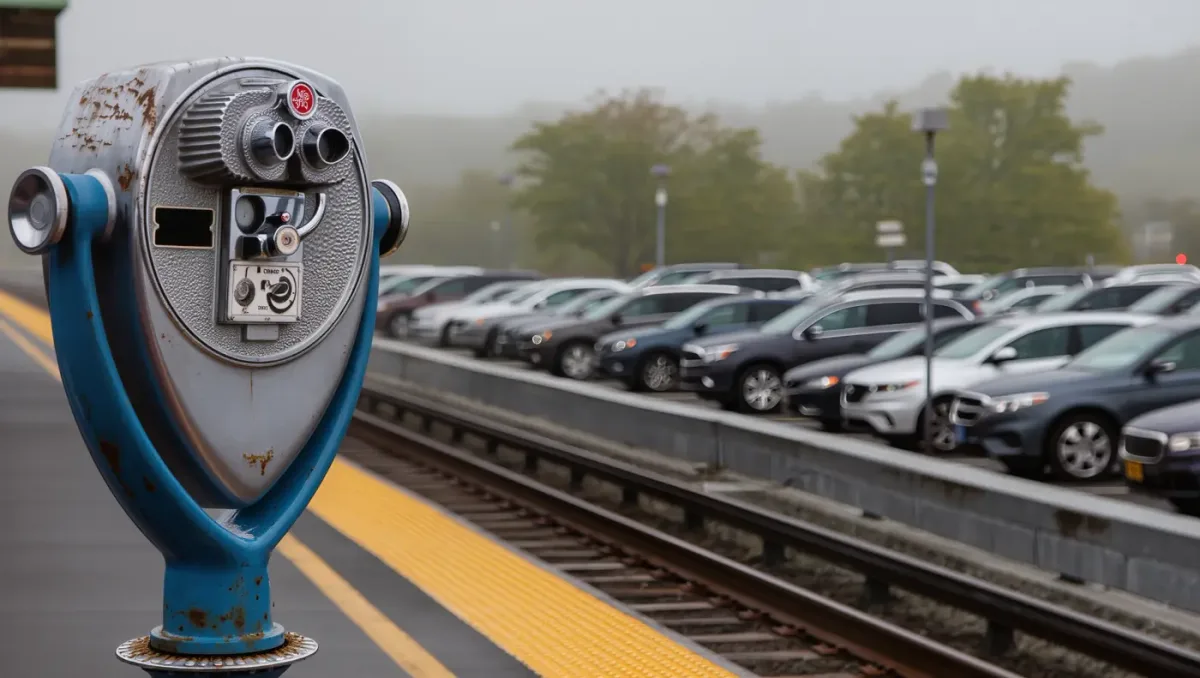
Because driving to a rail or bus stop is step one for nearly everyone, parking is the commodity that governs the system. Permit lots at Suffern and Pearl River stations fill with resident permit holders in the dark, and the surrounding municipal lots absorb overflow — a daily migration local businesses have built their hours around.
What does the morning rush buy?
The commuter's day starts as a sequence of small purchases with strict time limits. Coffee and breakfast sandwiches between 6 and 8 a.m., dry cleaning drop-offs, convenience stops for transit cards and gas, and a steady trade at delis and bagel shops within a five-minute drive of the stations. In Suffern, shops on Lafayette Avenue open early to catch the Port Jervis Line crowd walking from the municipal lots across the tracks; in Pearl River, the walk from the permit lots to the station platform passes straight through the downtown, funneling riders past storefronts that set their opening times to the Pascack Valley schedule.
Parking lot operations are themselves a business line for municipalities. Permit fees, meters, and enforcement in station lots generate revenue that towns and villages bank against lot maintenance and shuttle service — and every rate discussion at a trustee meeting is, underneath, a commuter-economy debate.
Why is the evening economy the real prize?
The morning rush is quick money, but the evening is where commuters convert into full customers. A rider reaching Suffern at 6:45 p.m. is a candidate for dinner, groceries, a haircut appointment, youth sports drop-off, or a drink with a colleague before the drive home. Downtowns near stations deliberately program for that window: restaurants taking the 7 p.m. reservation, shops staying open late for Thursday and Friday evenings, and seasonal events scheduled around train arrivals.
Real estate agents have long marketed Rockland's station villages on this quality of life — walk to the train, walk home to dinner — and the businesses that survive downtown turnover are disproportionately the ones that can monetize both ends of the commute. A shop that only sells between 10 and 4 misses nearly the entire commuter wallet.
How do park-and-ride lots support local trade?
Park-and-ride capacity acts like free advertising for the businesses around it. A lot full at 7 a.m. means roughly a hundred cars parked within walking distance of nearby storefronts, and owners near the Pearl River and Suffern lots time deliveries, staffing, and sidewalk displays to that guaranteed morning density. Municipalities have reinforced the link by placing shuttle stops and farmers’ market sites at or next to station lots, converting parked commuters into Saturday shoppers without adding a single parking space. For a downtown, the lot is not parking policy so much as customer traffic policy.
What happens when commute patterns shift?
The commuter economy's dependence on the New York job market is its strength and its exposure. Remote and hybrid work, which spread after 2020, changed the calculus: fewer five-day riders meant thinner morning trade and lighter station-lot demand, and communities nationwide documented reduced transit ridership and altered downtown foot traffic. Rockland felt it in the same direction — but the county's housing costs push many residents to keep commuting in some form, and hybrid patterns concentrate trips on Tuesday through Thursday, which shifts but does not erase the midweek trade.
Businesses adapted in familiar ways: expanding weekend and evening hours, leaning on delivery platforms for weekday lunch volume, and treating the Monday and Friday rider as the exception worth planning for rather than the rule.
Who wins in a commuter-driven economy?
Three business types consistently benefit. First, food and drink near stations, because the commuter buys in time-constrained windows on a fixed schedule. Second, service businesses — dry cleaners, barbers, childcare — that can transact at either end of the day. Third, the municipalities themselves, whose parking revenue and downtown property values ride the same ridership curve. The flip side is fragility: a schedule change on the Port Jervis Line or a parking rate hike ripples through Main Street cash registers within weeks, which is why station villages watch NJ Transit timetables the way port towns watch the tide.