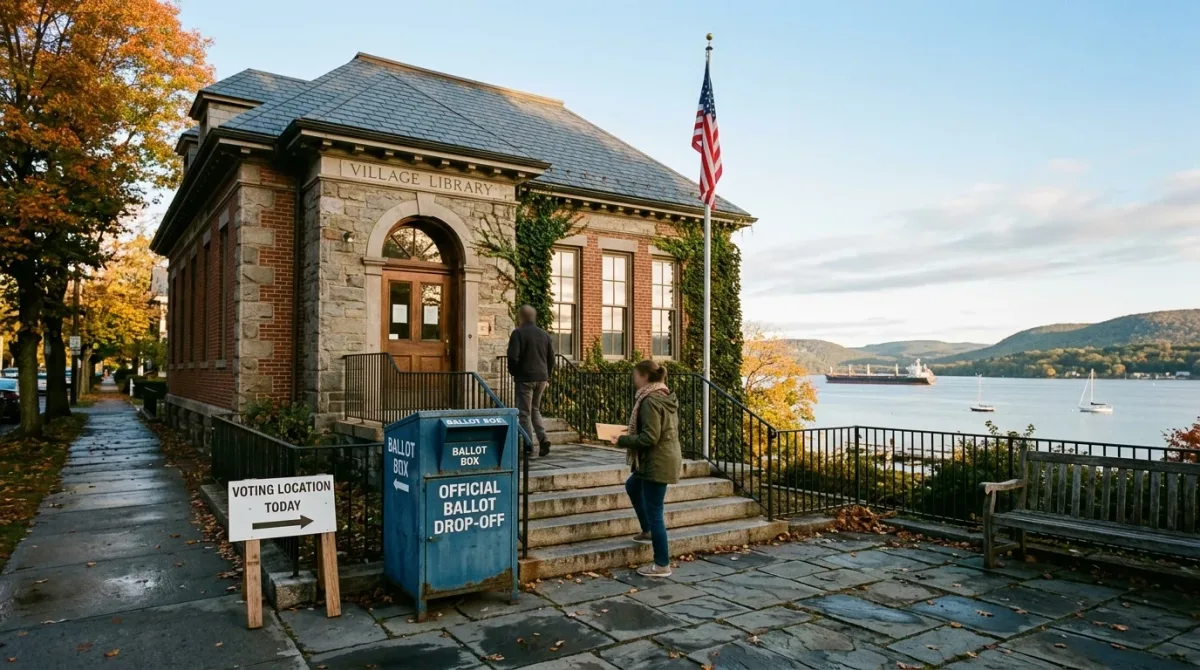
Rockland County's public libraries are not county departments and they are not town departments. Each one is separately chartered by New York State, and most are paid for by a property tax levy that voters inside a defined service area approve directly, on a ballot the library's own trustees write, apart from any town or county budget.
Who actually votes on a library budget?
In most cases, the residents of the library's chartered service area do — in person, at a poll, on a proposition the library's board of trustees put in front of them. State law treats library money as its own question rather than a line inside somebody else's spending plan.
Section 259 of New York's Education Law says that taxes "in addition to those otherwise authorized, may be voted for library purposes," and that in a school district the appropriation "shall be submitted to the voters of the district as proposed by the library board of trustees in a separate resolution," according to the statute text published by the New York State Senate.
The same section walls the money off once it is collected. All money received from taxes or other public sources for library purposes "shall be kept as a separate library fund by the treasurer," the statute says. A library levy is accounted for separately from the general municipal money it was raised alongside.
Section 259 also gives residents a way to start the conversation themselves. Where 25 qualified voters of a municipality petition and the library board of trustees endorses the request, the question of establishing or increasing library funding is put on the ballot at that municipality's next general election, provided due public notice has been given. An increase approved that way does not reach back into a municipal budget already adopted before the election.
What kinds of libraries does Rockland have?
Four types exist in state law, and the difference between them is mostly a question of who holds the pen on the budget. The New York State Library's statewide directory of public libraries sorts every library into association libraries and public libraries, then subdivides each by the body that chartered it — city, county, town, village, school district or special legislative district.
The State Library's public library district toolkit sets out what each of those labels means in practice.
| Type | Chartered by | Who approves the budget |
|---|---|---|
| Association library | Vote of association members, or trustees operating under a will or deed of trust | No direct public budget vote; may receive government appropriations by contract, or a levy approved by municipal or school district voters |
| Municipal public library | Vote of a county, city, town or village board, or by petition and referendum | The county, city, town or village board |
| School district public library | Vote of the school district's voters | School district voters, directly |
| Special district public library | Special act of the State Legislature plus a vote of district voters | District voters, directly |
All four types can end up looking identical from the sidewalk. The distinction announces itself exactly once a year, on the day the number is decided, and only then does it matter whether you personally get a ballot.
Why does Haverstraw's library have its own district?
Because the state gave it one. Haverstraw King's Daughters Public Library says it was designated a "Special Library District" in 1978, "to give residents the opportunity to vote on the annual budget and trustees," according to the library's account of its own history. That is the fourth row of the table above, and it is the arrangement that puts the annual number directly in residents' hands.
The library traces itself back considerably further. Its history states that on November 21, 1895 the King's Daughters Society, a charitable organization, petitioned the New York State Regents for a charter, that the charter was signed by Melvil Dewey, and that the result is the oldest chartered public library in Rockland County. The main building opened in 1903 at the foot of Main Street after a local brickyard owner, Denton Fowler, donated half the construction cost.
Today the library operates from a main building at 10 West Ramapo Road in Garnerville and a branch at 85 Main Street in Haverstraw, according to the member directory maintained by the Ramapo Catskill Library System.
Why does Nyack vote on a different calendar?
Nyack Library runs its budget vote and trustee election on its own schedule rather than alongside a May school ballot. The library's posted notice set its poll for a Tuesday in February, with voting from 10 a.m. to 8 p.m., and drew a distinction between the two questions on the ballot.
For the budget, the library's notice says eligibility belongs to "Residents of the Nyack Library service area who are currently registered with the Rockland County Board of Elections." For the trustee election, it says "Residents (18 years and older) of the Nyack Library Chartered Service Area are eligible to vote." The registration requirement is the practical catch: a resident who has never registered to vote can be inside the service area and still be turned away from the budget question.
Trustee seats do not all run on the same clock either. The library's vote notice listed a slate mixing three-year, two-year and one-year terms, with seats filled in order of the number of votes each candidate received. Dates and seat counts change from year to year, so the library's own notice is the thing to check before making the trip.
Who is above the individual libraries?
Two organizations, and neither of them runs anything. The Ramapo Catskill Library System serves public libraries in Orange, Rockland, Sullivan and southern Ulster counties, and its member directory lists 17 in Rockland alone: Blauvelt Free Library, Haverstraw King's Daughters, Nanuet Public Library, New City Library, Nyack Library, Orangeburg Library, Palisades Free Library, Pearl River Public Library, Piermont Public Library, Sloatsburg Public Library, Finkelstein Memorial Library in Spring Valley, Rose Memorial Library Association in Stony Point, Suffern Free Library, Tappan Library, Tomkins Cove Public Library, Valley Cottage Library and West Nyack Free Library.
The Library Association of Rockland County is the other. It describes itself as a professional membership organization whose mission is to "support and promote public libraries, public library development, and public library services in Rockland County, NY," with a stated objective "To promote cooperation among libraries in Rockland County." Its executive board is drawn from library directors, and the organization's own listing names directors from Haverstraw King's Daughters, Valley Cottage, Palisades Free, Tappan, Nanuet, West Nyack Free, Nyack, New City and Orangeburg.
Neither body sets a member library's tax levy. That stays with the chartering authority and, where the charter provides for it, with the voters.
How do I find out which library I vote for?
- Start from your address. The State Library's statewide directory lets you filter public libraries by county, school district, library type and library system, which is the fastest way to see which chartered library your address sits inside.
- Read the library's own site for the phrase "chartered service area." Nyack Library uses exactly that language on its vote page, and a service area is not always the same shape as a village boundary.
- Check the library type. If it is a school district public library or a special district library, you get a direct vote on the budget. If it is a municipal library, your town or village board approves it and the place to be heard is a board meeting.
- If your library's ballot requires it, confirm you are registered with the Rockland County Board of Elections well before the vote, not on the day.
- Watch for the library's posted notice. Vote dates in Rockland are not synchronized, and a February poll and a May poll can both be happening in the same county in the same year.
None of this is exotic. It is simply that New York decided, more than a century ago, that a library's money should be asked for out loud and kept in its own pocket — and Rockland's 17 libraries each inherited a slightly different version of that arrangement.
For a related government perspective, read How to request public records from Rockland's town and county governments.